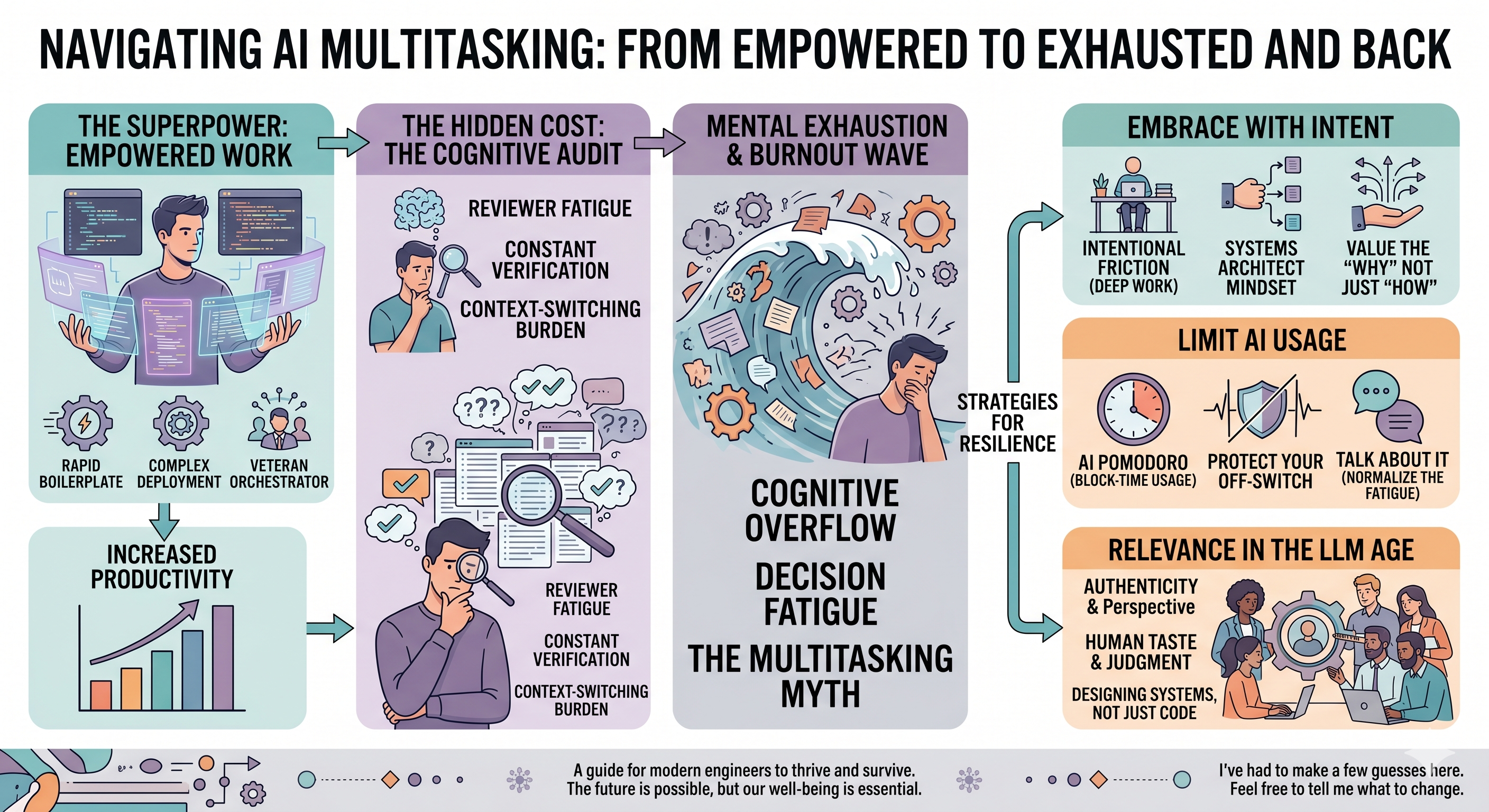
In a world where we can spin up a UI in seconds or resolve complex merge conflicts with a single prompt, the exhaustion isn’t from the work itself — it’s from the sheer volume of decisions we now have to make at a breakneck pace.
The Paradox of “Infinite” Productivity
We’ve moved from being “coders” to “orchestrators.” Whether it’s using LLMs to manage complex mobile release builds or leaning on them for Jetpack Compose boilerplate, the speed is intoxicating.
The empowering reality: we can now tackle projects that used to require a whole team. Anything is possible.
The hidden cost: just because we can do more doesn’t mean our brains have evolved to process the context-switching that comes with it.
The Auditor’s Burden and Mental Exhaustion
Burnout in the AI era looks different. It’s not “I have too much to type” — it’s “I have too much to verify.”
When an LLM generates 100 lines of code in three seconds, your job shifts from creating to auditing. Constant auditing is mentally taxing because you’re looking for subtle hallucinations or logic gaps while trying to maintain the big-picture architecture.
AI allows us to run five “workstreams” at once, but our “RAM” is still single-threaded. This leads to a unique flavor of burnout: Cognitive Overflow.
Embracing the Wave (Without Drowning)
To stay relevant, we have to use these tools, but we must use them with intent.
Intentional Friction: Sometimes, the best way to help yourself is to stop using AI for a moment. Write that logic by hand to re-engage your deep-thinking muscles.
The “Systems Architect” Mindset: Move your value proposition away from “writing code” toward “designing systems.” AI is great at the how, but it struggles with the why. Focus on the why — the business impact, the engineering excellence, and the user experience.
A Survival Guide for the Modern Engineer
-
The AI Pomodoro: Dedicate specific blocks of time for “AI-assisted sprinting” and “Deep-work silence.” Do not let the LLM be an open tab all day.
-
Talk about the fatigue: Normalize the fact that “fast” doesn’t always mean “easy.” Sharing this with your team helps reduce the pressure to produce at an inhuman rate just because the tools allow for it.
-
Protect your off-switch: In an age where anything is possible 24/7, the most valuable skill is knowing when to close the laptop and take a walk.
We are the first generation of engineers learning to code at the speed of thought. Let’s make sure we don’t outrun our own well-being in the process.
What strategies have helped you find balance? Let’s continue the conversation on LinkedIn.
Comments