In 2018, after briefly working on improving the memory footprint for the Amazon Flex (Rabbit) app, I transitioned to the Amazon Care (PH7-Tangelo) team. I was incredibly passionate about the healthcare space and wanted to help Amazon cross the finish line on an initiative that could solve real-world problems and genuinely improve people’s quality of life.
My time at Amazon Care was defined by moving from a specialized Android developer to a cross-platform technical leader. Here is a deep dive into the major features, architectural decisions, and scaling challenges I tackled while building the foundation of Amazon’s healthcare platform.
1. Engineering the Telehealth Video Stack: From WebRTC to Chime
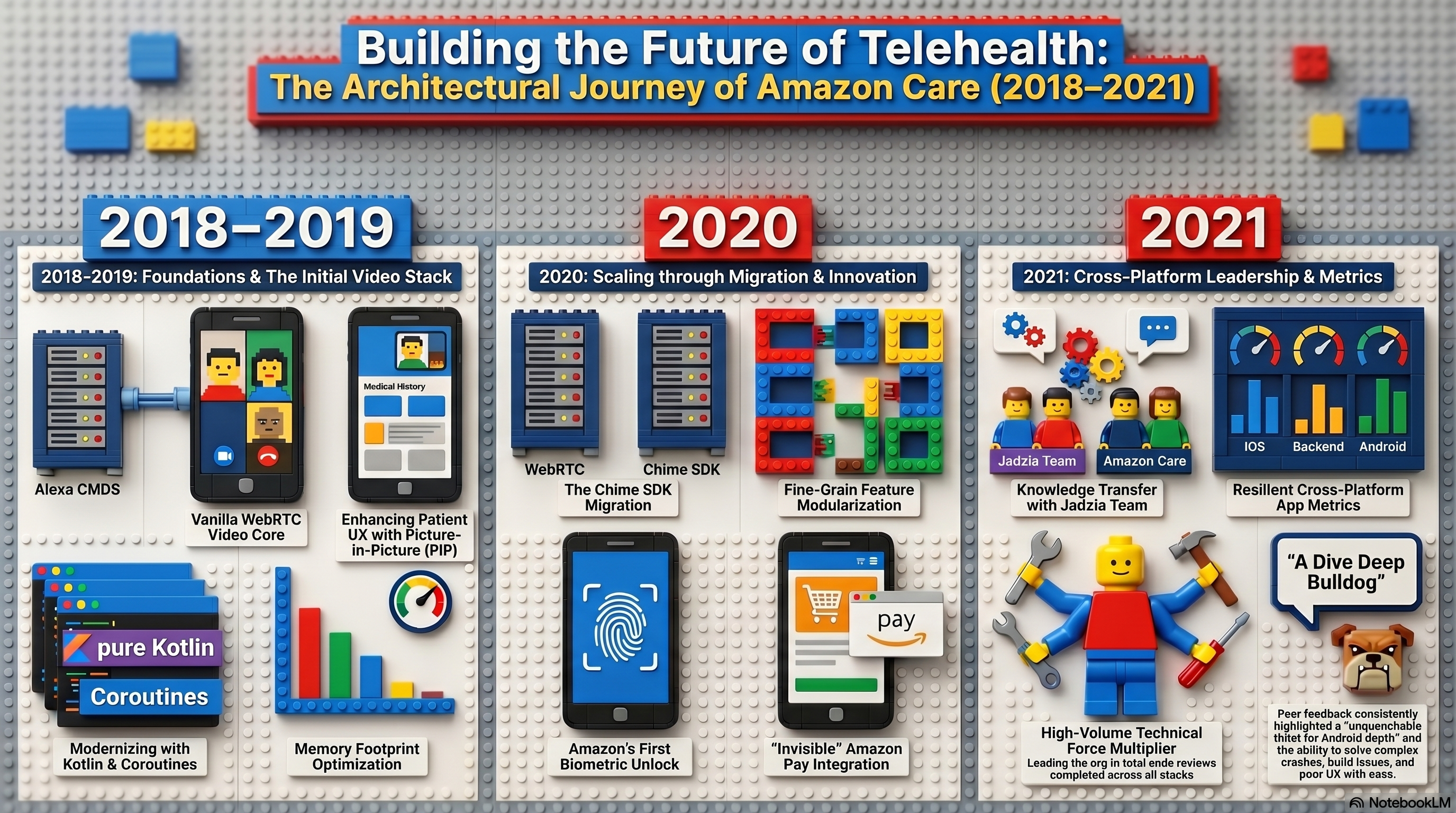
Telehealth relies entirely on stable, reliable communication. In 2018 and 2019, I led the implementation of a rock-solid end-to-end video calling solution for medical providers. This required building the core architecture to securely send and receive calls, while also implementing complex support for Picture-in-Picture (PiP) mode so patients could navigate the app without dropping their session.
Initially, our video architecture was built entirely on Vanilla WebRTC and utilized Alexa CMDS servers. As the platform scaled, however, we needed a more robust infrastructure. In 2020, I assisted the team in migrating our existing video stack over to the new Chime SDK. Rather than just copying and pasting code, I directly mentored a peer developer to ensure my previous use cases and custom features were properly supported on the new Chime infrastructure.
My deep dive into video calling also allowed me to act as a subject matter expert beyond my immediate team. I organized a knowledge transfer with the Jadzia team to share my learnings on video calling. I proactively reached out to them to highlight architectural issues they would face in the future and provided technical alternatives to ensure their success.
2. Modernizing the Tech Stack and Scalable Modularization
When building a new, large-scale application, setting the right foundational patterns is critical. I championed team-wide architectural decisions to move the entire Amazon Care app to pure Kotlin and Coroutines, setting a modern standard for Android development within our org.
As the project grew, I anticipated the need for multiple development teams to work simultaneously. I introduced fine-grain feature modularization to the application. This architectural shift provided clean code separation and isolation, allowing new teams to be spun up quickly and contribute to the app without stepping on each other’s toes.
3. Pioneering Biometrics & Seamless Payments
In healthcare applications, security and seamless user experiences are paramount. I am incredibly proud to have engineered Amazon’s very first app with biometric unlock capability.
Additionally, we needed a way to process payments without jarring the user out of the native app experience. I developed a seamless integration with Amazon Pay on Android using a WebView loaded directly into memory without ever attaching it to the view hierarchy. This approach created a beautiful, native-feeling user experience where customers could process payments without ever realizing they were interacting with a web page.
4. Cross-Platform Leadership & Driving Metrics
In my final years at Amazon Care, my focus expanded to maximizing my force-multiplying impact on the broader organization. Refusing to be siloed solely in Android, I dedicated time in 2020 to learn iOS and Backend development. This allowed me to stretch my impact and significantly lead the team in the number of code reviews completed across Android, Web, and Backend services.
I also took a leadership role in the App Metrics project to track customer engagement. This was a massive undertaking that had me touching iOS, backend, frontend, and Android pieces to build a resilient, cross-platform solution. While it was an ambiguous and challenging project that required heavy alignment with existing teams like ACE, it taught me valuable lessons on building consensus and program managing complex cross-org dependencies.
Conclusion
Building Amazon Care was a profoundly rewarding experience. From pioneering biometric security to building life-saving telehealth video infrastructure on WebRTC and Chime, I thrived on optimizing for speed and efficiency. It pushed me to continually insist on the highest standards, dive deep into unfamiliar technical territory, and balance my obsession for engineering purity with delivering fast, impactful healthcare solutions for our customers.
What questions do you have about building healthcare technology at scale? Let’s connect on LinkedIn.
Comments